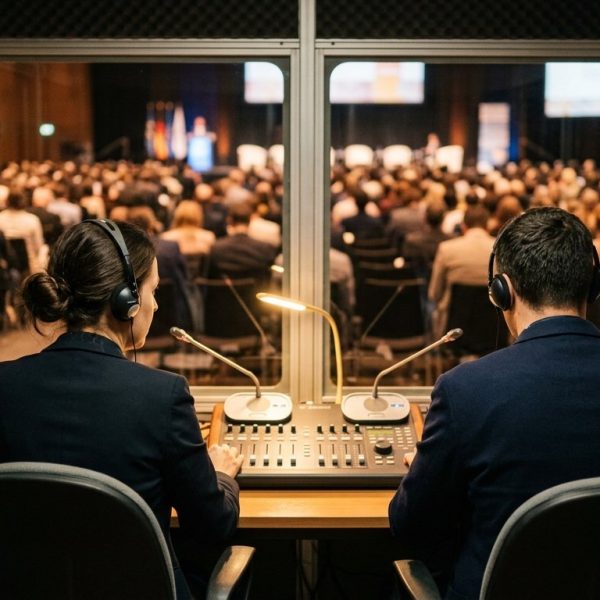
The first time you sit behind the glass at a multilingual conference, the thing that surprises you is not the speed. It is the silence between the two people in the booth. One is speaking almost continuously into a microphone, half a sentence behind the speaker on stage. The other is writing numbers on a notepad and sliding it across. Simultaneous interpretation looks like one person performing, and it is nearly always two people working, with one of them doing the part the audience never hears.
Why It Is Two People and Thirty Minutes
Interpreters in simultaneous mode switch roughly every twenty to thirty minutes. This is not a union rule invented to inflate invoices. Listening and speaking at the same time, in two languages, while holding a speaker's argument in working memory, degrades measurably after about half an hour. Accuracy drops before the interpreter notices it has dropped, which is the dangerous part.
The partner in the booth is not resting either. They write down figures, proper nouns, acronyms and anything the active interpreter is likely to miss, and they handle the technical fault when a channel dies. Anyone quoting for a full conference day with a single interpreter per language is quoting for something that will not hold up past lunch, and the professional bodies are explicit about this. AIIC's guidance for clients sets out the working conditions that make the output reliable rather than merely continuous.
Simultaneous, Consecutive and the Money Between Them
Consecutive interpreting means the speaker talks, stops, and the interpreter delivers the passage from notes. It needs no booth and no hardware, and it roughly doubles the length of the session. For a two hour bilateral negotiation or a ceremony it is often the better choice, and it costs far less.
Simultaneous does not extend the agenda at all, which is why it dominates conferences with several working languages. The trade is hardware: booths, transmitters, receivers, a technician. Whispered interpreting, sometimes called chuchotage, sits between the two and works only for one or two listeners in a quiet room.
The mode should be chosen from the agenda, not from the budget line.
Remote Changed the Logistics, Not the Craft
Video remote interpreting moved from the margins to the default for internal meetings almost overnight, and it has held its position because the savings on travel are real. What did not change is the requirement for clean sound. An interpreter can work with an imperfect speaker and a confusing slide deck. They cannot work with a laptop microphone in a room with three people sharing it, because the compression that makes speech intelligible to a human listener strips out exactly the cues an interpreter relies on.
The practical rule is one microphone per speaker, headsets rather than open speakers, and a wired connection for anybody who will talk for more than a minute. Teams that get this right find remote sessions almost indistinguishable in quality. Teams that do not spend the session apologising. Choosing professional interpreting services with real remote experience matters more here than in a physical venue, because the failure modes are technical rather than linguistic.
Preparation Is the Whole Job
Here is the part clients underuse. An interpreter who receives the slide deck, the agenda, a participant list and any internal acronyms three days ahead will perform noticeably better than one who receives nothing. They are not reading the material to translate it in advance. They are building the vocabulary and the mental map so that when your chief financial officer says something compressed and idiomatic about a product line, the interpreter already knows what the product line is.
Speeches that will be read aloud should be shared even if the text is confidential, under a non disclosure agreement if necessary. Read speeches are by far the hardest thing to interpret, because the delivery is faster than natural speech and offers none of the redundancy that spontaneous talk provides.
The booth shows how much language work happens under pressure, with no second draft and no chance to revise a phrase once it has left the microphone. Written work runs on the opposite principle, which is why certified translation services build in terminology control, a review pass and a formal statement of accuracy before anything is delivered. Interpreters and certified translators solve the same problem from two very different ends of the clock.
A short briefing call is worth more than another hour of interpreter time. Ten minutes on who will speak, in what order, and what the sensitive topics are will change the quality of the day.
What to Ask Before You Book
Ask for the interpreters' language combinations written properly, with the direction specified, since working into a native language is not the same as working out of it. Ask whether the booths meet the relevant ISO standards, or for remote work, which platform and whether the interpreters have used it before. Ask who the technician is and when they arrive, because a technician who turns up thirty minutes before the opening address is a risk you are carrying yourself.
If the terminology in your sector is unusual, ask whether the team will build a glossary and whether you get to review it. You almost certainly have internal preferences that no outsider would guess.
For a clear comparison of the modes and when each one fits, PoliLingua's breakdown of simultaneous and consecutive interpretation is a practical starting point for an internal discussion before you request quotes.
A Note on History
None of this existed at scale before 1945. The technique was proposed in the 1920s and proved at the Nuremberg trials, where four working languages and a court that could not afford to run at consecutive speed forced the issue. The origins of simultaneous interpretation are unusually well documented, and the equipment in the photographs is recognisably the ancestor of what sits in a booth today.
Eighty years on, the constraint has not moved. The technology got smaller and the meetings got shorter, but the limit is still a human being holding two languages open at once, and that is why the preparation you send ahead is the cheapest quality improvement available to you.